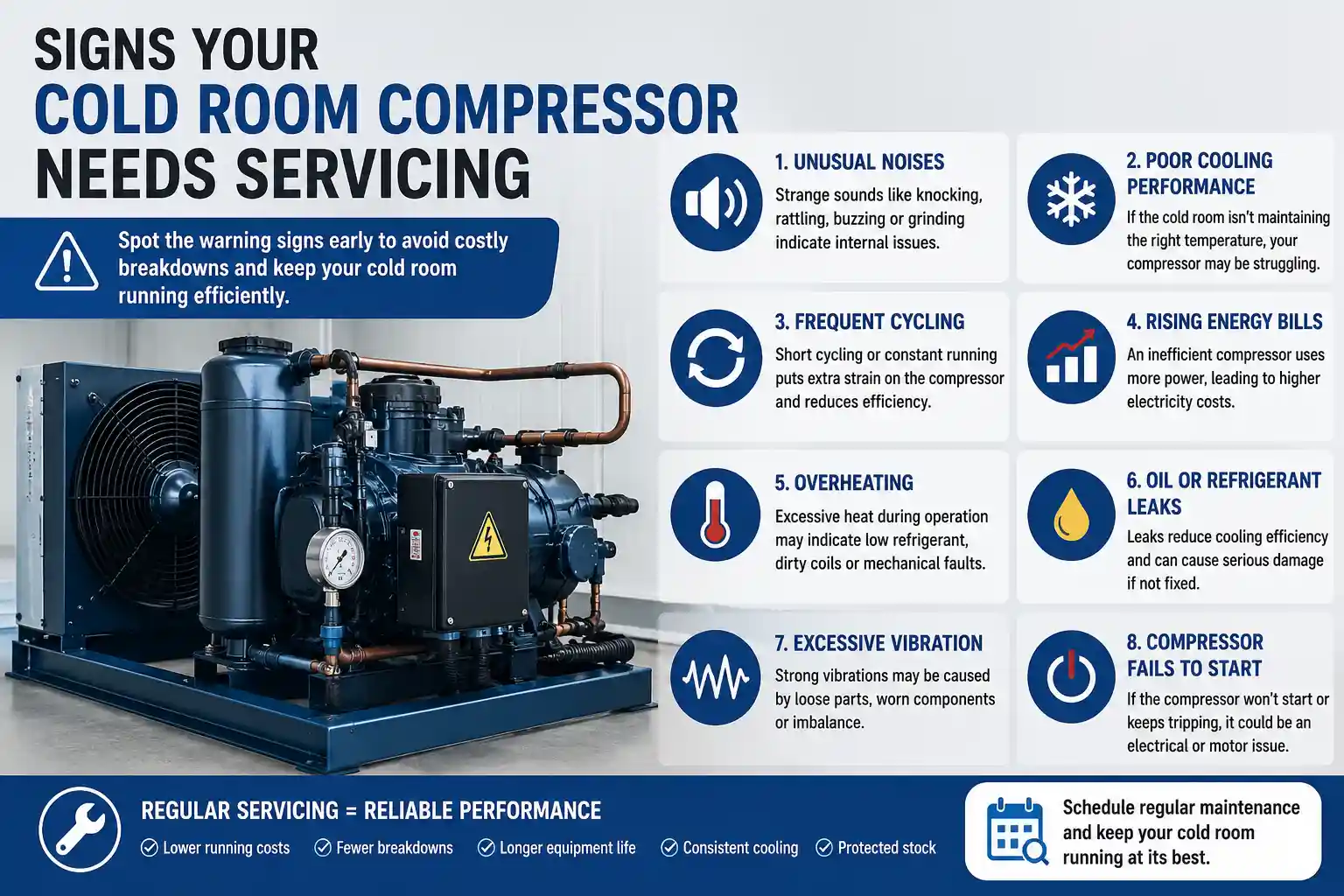
Signs your cold room compressor needs servicing
A cold room compressor plays a vital role in maintaining the correct temperature for storing perishable goods such as agricultural products, pharmaceuticals items, dairy and ice-cream products and meat and poultry items. It acts as the heart of the refrigeration system. The compressor works continuously to circulate refrigerants and take out heat from the cold room. However, like any mechanical equipment, compressors can develop issues if used for a long period of time. Once you use the compressor for a longer period of time, it begins to show signs such as unusual noises, poor cooling performance, increased electricity bills, frost or ice buildup and oil leaks. If such issues develop, it needs proper servicing. By recognizing the signs of the compressor early, you can prevent costly breakdowns, product spoilage, and increased energy consumption.
In this blog, we provide information about what a cold room compressor is, how it works, why a cold room compressor needs servicing, signs that indicate your cold room compressor needs servicing, and what happens when you skip your servicing.
What is a cold room compressor?
A cold room compressor is the core part of refrigeration systems that is used to cool and maintain the temperature of the cold room by compressing the refrigerant gas and distributing it all over the system. It removes the heat from the cold room and releases it outside by using a pressurized refrigerant cycle. The cold room compressor acts as the heart of the cold storage room. It can effectively maintain the low temperatures and relative humidity that are needed to reduce bacterial proliferation, enzyme function, and degradation of several types of goods. This refrigerated storage system helps in preserving the agricultural products, pharmaceuticals items, dairy and ice-cream products and meat and poultry items.
Why does your cold room compressor need servicing?
As stated earlier, a cold room compressor is the heart of the refrigeration system. Without it, the cold room cannot operate effectively. While using this compressor continuously for a longer period of time, it can lead to damage and degradation of internal components, reducing efficiency and increasing energy consumption. Therefore, a cold room compressor needs timely servicing. Below are some of the reasons why a cold room compressor needs servicing.
- Maintain cooling performance: While using the compressor for a longer period of time, dirt, moisture and debris can build up, which can affect the refrigerant flow and heat transfer. With the help of proper servicing, the compressor can provide consistent cooling performance.
- Reduce energy costs: A poorly maintained compressor requires hard work to maintain its cooling performance. This can consume excessive power, hence, more cost. By doing proper servicing, it can improve the overall efficiency of a cold room compressor, thereby reducing the energy cost.
- Prevent costly failures: Through conducting the regular inspection, you can identify problems such as refrigerant leak, electric motor malfunctions, vibrations, low refrigerant charge and worn bearings. If you identify these problems at an early stage, you can perform servicing and avoid a high cost.
- Protect stored products: If the compressor fails to perform, the temperature inside the cold room rises rapidly. This can spoil the stored products in a short time. With the proper servicing, the compressor works efficiently, helping the stored products remain safe, fresh and good in quality.
- Extend equipment lifespan: When the cold room compressor is not serviced for a longer period of time, it can cause several problems and can reduce its lifespan. By timely servicing, it can help to extend the lifespan of a compressor.
How Does a Cold Room Compressor Work?
A cold room is one of the main components of the refrigeration system that ensures that low temperatures are kept for preserving the perishable items. It operates through the stepwise process. Understanding the stepwise process on how cold room compressors works helps in ensuring proper functioning, energy savings and effective temperature maintenance. Below is the process involved in working of a cold room compressor.
- Step 1: Compression (The Compressor): From the evaporator, the compressor receives the low temperature and pressure refrigerant gas. Then, the gas is subjected to mechanical compression so as to increase its temperature and pressure of the refrigerant.
- Step 2: Condensation (The Condenser): From the compressor, high pressure gas results due to mechanical compression moves to the condenser. In the condenser, the fans are fixed. These fans blow the cool air from outside towards the condenser coils. This process makes sure that refrigerant releases its heat to the external environment and transforms into the high-pressure liquid.
- Step 3: Expansion (Expansion Valve): The high-pressure liquid refrigerant moves into the expansion valve. In the expansion valve, there is a fast reduction in pressure that causes the refrigerant to instantly expand and transform it into ultra low-pressure gas-liquid mixture.
- Step 4: Evaporation (The Evaporator): This cold gas-liquid mixture is passed through the evaporator coils present in the cold room. After this process, the hot air existing in the room is circulated with the help of a blower fan through these coils. The heat of the air in the room is absorbed by the liquid refrigerant, and thus, it is turned back into vapor form. Then, the cold air is blown back to the cold room, and vaporized refrigerant is drawn back to the compressor.
Signs your cold room compressor needs servicing
A cold room compressor is a crucial factor that helps to maintain a consistent temperature throughout the cold room. When it is used for a long time, it begins to develop problems. Once it shows problems, the compressor starts to show warning signs before it completely crashes out or fails. Noticing these warming signs and performing servicing in time can help you prevent costly repairs, product spoilage, and system downtime. Some of the signs your cold room compressor needs servicing are listed below:
- Unusual Noises: Normally, when a healthy compressor is operating, it produces a steady operating sound. However, if you hear sounds such as grinding, clanking, buzzing, and banging sounds, the compressor needs the services as it can be a sign of loose parts and mechanical damage.
- Poor Cooling Performance: If your cold room compressor struggles to reach or maintain the desired set temperature, it might be that your cold room compressor is not adequately compressing the refrigerant. In such a case, your cold room compressor requires urgent servicing.
- Compressor Running Continuously: A compressor that runs without stopping is also a sign of servicing. Nonstop working of the compressor indicates that it has low refrigerant levels, dirty condenser coils, worn compressor components and poor system efficiency.
- Increased Electricity Bills: In case of unexpected higher electricity costs despite using the same amount of electricity, this is another indication of servicing. The cost of electricity bills goes up if your compressor has to put in more effort than usual for achieving the same cooling effect.
- Oil Leaks: Around the base of the compressor, you may see visible oil leaks. This indicates that damage seals, refrigerant leaks and compressor wear. Once you notice it, your compressor needs immediate servicing.
- Frost or Ice Buildup: Having some ice in the cold room is normal, but if you see excessive frost on refrigerator lines, evaporators and cold rooms, it is a sign of refrigerant flow issues, expansion valve problems and compressor inefficiency. Once you get the signs, you should immediately perform servicing.
What happens when servicing is skipped?
Servicing of cold room compressors is extremely important for maintaining the desired temperature and for effective performance of the refrigeration system. Hence, it is important to maintain the compressors through proper servicing to keep up their efficiency and to protect the temperature-sensitive products. However, if you skip/neglect the servicing even once, it may leads to various problems, which are mentioned below:
- Reduced Cooling Efficiency: When the cold room compressors do not get servicing at the time, you may see dust, dirt and debris. It leads to the increased effort put by the refrigeration system to maintain the desired temperature. As the system works hard over time, the cooling performance of the compressor slowly declines.
- Compressor Failure: The compressor can get damaged or fail if not serviced in time. If you do not perform servicing, the compressor can overheat, refrigerant leaks, electrical strain and short cycling, causing complete compressor failure.
- Product Spoilage: By neglecting the servicing on time, the dirt, moisture and mechanical wear can cause system inefficiencies or damage the parts, leading to temperature fluctuation. This fluctuation can significantly affect the product, causing spoilage.
- Safety Risks: The electrical faults, overheating components, and high system pressures can create safety risks for operators and maintenance personnel if skipped/neglect the cold room compressor servicing timely.
- Higher Long-Term Costs: The skip of service of a cold room compressor can save some money in the short term. However, in the long term, it may result in many other issues such as expensive energy bills, spoilage of goods, sudden breakdowns and expensive repairs, leading to the increased operational costs.
Conclusion
Recognizing the signs that your cold room compressor requires servicing to maintain an efficient and reliable refrigeration system. When you experience signs like unusual sounds, poor cooling performance, oil leaks and increased electricity bills, then it is something you should not ignore them at any cost. By addressing these issues early with the help of regular maintenance, you can prevent major equipment failures, reduce operating costs, and extend the lifespan of the compressor. It is also important that performing regular servicing can protect your temperature-sensitive products from spoilage. Moreover, it also ensures consistent cold room operation. By performing the servicing in a timely manner, your business can improve system reliability and avoid unexpected disruptions to its operations.
In this blog, we provided information about what a cold room compressor is, how it works, why a cold room compressor needs servicing, signs that indicate your cold room compressor needs servicing, and what happens when you skip your servicing. For further information regarding cold storage rooms, do check out some other blogs. Additionally, if you are in search of an ideal cold storage room, contact Nepcool - one of the best cold storage rooms and refrigerated transport manufacturers in Nepal.
Recommended Blogs:
Best material for the cold room
Cold Storage Solution for Poultry
Cold Storage Capacity: How Much Space Do You Really Need
FAQs on cold room compressor
How can I make my cold room compressor more efficient?
There are various ways through which you can make your cold room compressor more efficient. Some of them are listed below:
- By doing regular cleaning.
- By performing servicing in a timely manner.
- By performing intelligent operations.
- By controlling temperature and doors.
How often should a cold room compressor be serviced?
A cold room compressor should be serviced in a timely manner. It is best to service the compressor at least twice a year by qualified refrigeration professionals.
How long do cold room compressors typically last?
The cold room compressor typically lasts for around 7 to 10 years if you don't perform timely servicing. However, by doing timely servicing, the compressor can extend its operational lifespan to 15 to 20 years.
